Saturday, April 2, 2011

Food in My Tho, Tien Giang, Vietnam


Vietnamese sour fish soup - canh chua ca


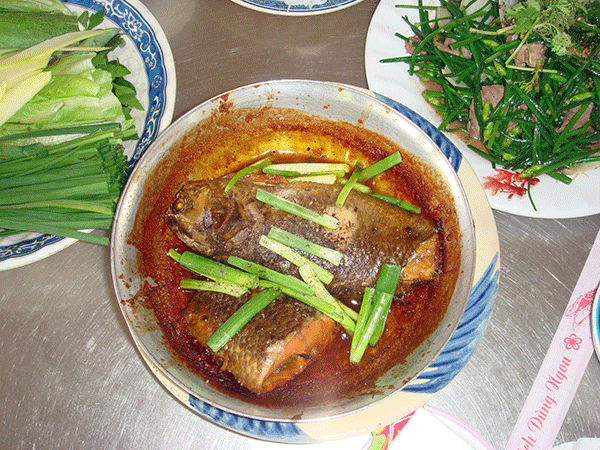
Vietnamese braised fish in claypot - ca ro kho to

On March 27-31, on our way to An Giang province, Vietnam, we stopped in My Tho for lunch with our Vietnamese research partners. These two dishes were among several we ate but my favorite is ca ro kho to, braised fish in claypot (see picture above). It is a tasty fish and the tamarind sauce makes it a perfect dish any time of the day.

The first picture is sour fish soup or canh chua ca. The fish is simmered on the table and the vegetables are added when the fish is nearly cooked. It has a sour and sweetish taste from ripe pineapple, spring onions, shallots, fresh root ginger, lemon grass and tamarind paste. Click the link for the recipe of canh chua ca.

Wednesday, August 26, 2009

Fruits from our farm


After a 2008 hiatus, our small fruit farm in Ormoc City has a bumper crop of tropical fruits -- Bangkok santol, mangosteen and lanzones (see photos above). It is a joy considering the extreme weather events of early rain and wind that have ran havoc to the fruits in Davao this year. And my sisters flew in from San Francisco this morning for a visit but primarily to pick lanzones. This lanzones picking has been two years in the making. First, my sister wanted to come over in 2007 when she learned about our fruits. I told her that it will be a case of delayed gratification because the trees only bear these fruits every other year. I'm so thrilled our fruit trees did not disappoint this year

On the phone, my sister said she will only eat fruits in Ormoc. I dangled other irresistible goodies -- lechon, Queen pineapple, langka, dried danggit. I have also arranged trips to our hometown, Carigara, to visit the market on market day, eat kinilaw, dilis fritters, bibingka, lupak na saging & balanghoy, rattan fruit, mala-igang, palawan and saba bananas. Such luxuries can only be found in one's hometown.

Tuesday, July 14, 2009

Dining in Hangzhou


On June 30 -July 4, I was in Hangzhou to conduct training in Jinhua. Hangzhou food is superb, never the greasy food laden with MSG that is often associated with Chinese cooking. The pictures above are just some of the dishes served at dinner I had with friends in Zhejiang University.

The first picture is a fish dish which is reminiscent of the Thai fried fish with soya bean paste, ginger and chilli. The next one is an eggplant dish sauteed in soybean paste and it is so delicious.

Monday, April 13, 2009

Irresistible Thai desserts


I was again in Bangkok in January and April for a workshop and I had time to sneak to the Chatuchak market. In January, the climate was quite pleasant but when I was there last week, the heat was rather extreme and I would describe it as "biting the skin". As I walked around thirsty and hot, I stumbled on a Thai dessert roadside stall which was just too hard to resist. Reminiscent of the halo-halo in the Philippines, this Thai dessert is also called ruan mitr or tab tim grob (red rubies), depending on the mix of goodies inside. I always like ruan mitr which I often order after a meal at MK restaurants.


At a field visit in Nakon Nayok province, we were served this sticky rice with coconut milk and banana and taro filling wrapped in banana leaves. The sticky rice part tastes like the Philippine suman but it is the filling that sets it apart. The piece de resistance was the ripe sweet tamarind (see photo below):


Last week, when I was in Bangkok, I had memorable meals, even those cooked in the countryside where we had our focus groups with farmers. Will post some photos in my next post.

Thursday, November 20, 2008

Don't blink when you buy in Divisoria streets

Just as I thought I was street smart as far as navigating around Divisoria was concerned, I've been had. A few weeks ago, I was shortchanged when I bought some round onions on Sta. Elena St. The price was cheaper than the supermarket and the round onions were of good quality -- shiny skin, no rotten parts, uniform medium sizes. But when I got home and started to put the onions on our small native basket, I found them to be of larger sizes and three pieces were even peeled. I stared at my purchase in disbelief. How could I buy large onions and choose peeled ones? Then I realized I've been had.

The modus operandi is for the seller to quickly switch the plastic bag of items you bought with another pre-packed bag while your eyes shifted from the weighing scale to your purse. You only discover this when you reach home and remove the contents from the bag.

Lesson learned -- In Divisoria, don't buy from the streets or roadside unless the seller is your suki. If you must, stand close to the weighing scale, keep your eyes on the scale, and grab the items first before handing the payment to the seller. That won't give the seller a chance to switch bags.

Monday, November 17, 2008

Marketman's Lechon Eyeball in Cebu


Photo credit: Marketman's Lechon (www.marketmanila.com)

I've been so remiss in updating this blog as my time was diverted to Devcompage. I've been to Penang, Singapore and Ho Chi Minh City in the past few weeks and I will share with you my food trips to these places in another post. But today, let me tell you about marketmanila's Lechon Eyeball in Cebu City that I had the great pleasure of participating in.

About 50 or so guests attended the marketmanila eyeball, There were three lechons made byMarketman's crew, one using the traditional Cebu style and two using his Accuchon style. Visit his blog for details of the lechon and his journey to a perfect Accuchon. The lechons were excellent and full of flavor that a crushed garlic-chili-vinegar dip was the perfect accompaniment to it. There was also a lot of lechon skin for everyone.

Besides the lechons, Marketman also laid out a tempting spread of several types of native salads -- guso, lato, eggplant, langka, green mango with sauteed bagoong -- crabs, prawns, lechon paksiw, kinilaw nga tangigue, grilled sweet corn, puso (hanging rice), budbud kabug (a suman made of millet, coconut milk and sugar), Mrs. U's silvanas and tocino del cielo, torta, small blueberry cheese cakes, biko, native ice cream and fresh fruits -- mangosteen, mango, pineapple.

Besides the scrumptious food, new friendships were made and a sense of community among kindred Marketman's fans pervaded the eyeball atmosphere. There were VIP guests too who were so unbelievably down-to-earth: Margarita Fores of Cibo fame, Frank Borromeo, the artisan chocolatier from Cebu, Mrs. U, the silvanas queen of Cebu, Joey of 80 Breakfasts, among others. It was a splendid Saturday indeed.

Thursday, March 27, 2008

Where to eat in Binondo

When in Binondo, the non-Chinese among us are often left in a quandary on where to eat without being challenged by price and menu choices. Our Chinoy friends who live right on Benavidez St. have long ago tipped us on where they go when the cook is on his day off. Here is a rundown of restaurants and food shops worth visiting.

Hopia. The most popular Binondo street is Ongpin and many would start their food buying spree at Eng Bee Tin for hopia. It seems to be the best-selling hopia in town and it has blazed the trail in making hopia ube, hopia pandan, and many other irresistible goodies. But a best kept secret among hopia connoisseurs is Holland Hopia. While on Ongpin Street, turn right on Nueva St. and walk for about 10 meters. There you will find Holland Hopia. This was the hopia lovers' favorite before Eng Bee Tin entered the scene. I like Holland hopia because it's less sweet than Eng Bee Tin's. Back in Ongpin Street, walk farther until you cross a bridge then turn left on Salazar St. A good landmark is the appliance store at the corner of Salazar and Ongpin streets. At the end of Salazar Street is Diao Eng Chay hopia factory. Besides hopia, Diao Eng Chay sells peanuts with garlic flakes, siopao, and many other delicacies. Cross the street enter Benavides Street where a row of Chinese restaurants await you.

President Restaurant. 746-750 Ongpin St. (near corner Salazar St.). Now under renovation, this could easily be the most upscale resto in Binondo. According to many accounts, most Philippine presidents have dined here, which perhaps explains why it is called President. President Restaurant and Waiying have the same owner but these two are miles apart in price, size of sevings, interiors, and ambiance. At President, there are so many items in the menu which are so scrumptious but our favorites are the white chicken (or Hainanese chicken) and hot prawn salad. The resto serves so many items, including those that are not on the menu. For instance, pancit canton is not on the menu but you can ask the waiter that it's what you want.

However, President Restaurant is closed for renovation.

President Teahouse - 809 Salazar St. Just around the corner from the President Restaurant is this tea house which serves excellent dimsum and noodles. Prices are cheaper than President Restaurant. There's also a pay parking opposite President Teahouse. Next to it, there's a Taiwan food store that you might consider dropping by as it has so many high quality Chinese food items (wife cake, husband cake, moon cake, etc.) that are so exquisitely wrapped, like Japanese stuff. For photos of the facade and goodies of President Teahouse, visit Wanderlust and Wish You Were Here.

Sincerity Restaurant - 497 Nueva St. (now Yuchengco St.) - opposite Trinity (an office supplies store) Order fried chicken, their famous specialty.

Golden Fortune Teahouse - 927 Benavidez St. Great food, newly renovated, comfortable and prices are reasonable. We used to go there quite often to order almond milk with ice, special tripe, beef brisket, mapo tofu and spare ribs, until it was renovated and the renovation took a year.

Wan Chai Restaurant - 918 Benavidez St. (opposite Golden Fortune Teahouse). The resto offers all the traditional Chinese dishes at reasonable prices. Try their dimsum, prawns or crab with sotanghon claypot, mapo tofu, mixed roast platter, and steamed fish head dimsum. As it gives good value for your money, you won't regret it.

Waiying Fastfood. This is one of our favorites. It is air conditioned but it's not for those who want peace and relaxation. But if you consider the food quality and reasonable price as a good tradeoff, then this place might just be for you The prices are very reasonable and the dimsums are so good. You can also take home all sorts of dimsum (siomai, hakaw, beef ball, etc.). Go upstairs (2nd floor) to avoid the chaos of a busy restaurant. When you go to Waiying, don't expect a fancy ambiance but think about the food and price. Based on the number of customers, this seems to be the favorite of the Chinoys. Here is where you will get the best value for money. Waiying sells a wide range of congee, chong fan, vegetables, dessert and drinks. Consider these prices: roast duck/asado rice - P120, roast duck/chicken rice - P120, lemon chicken rice - P100, yingyong rice - P100, steamed minced beef rice - P90, steamed chicken mushroom rice - P90, curry beef brisket rice - P90. For dimsum, here are the prices for 1 order: beef ball - P50, siomai - P55, chiu-chao dumpling - P50, hakaw - P60, kutchai dumpling - P50, vegetable dumpling - P50, etc. For drinks, Hong Kong milk tea - P40, HK milk tea cold - P45.